Disposable Face Mask Manufacturers in Turkey: Clinical Protection Standards and Technical Specifications
Disposable Face Mask: Definition and Clinical Applications
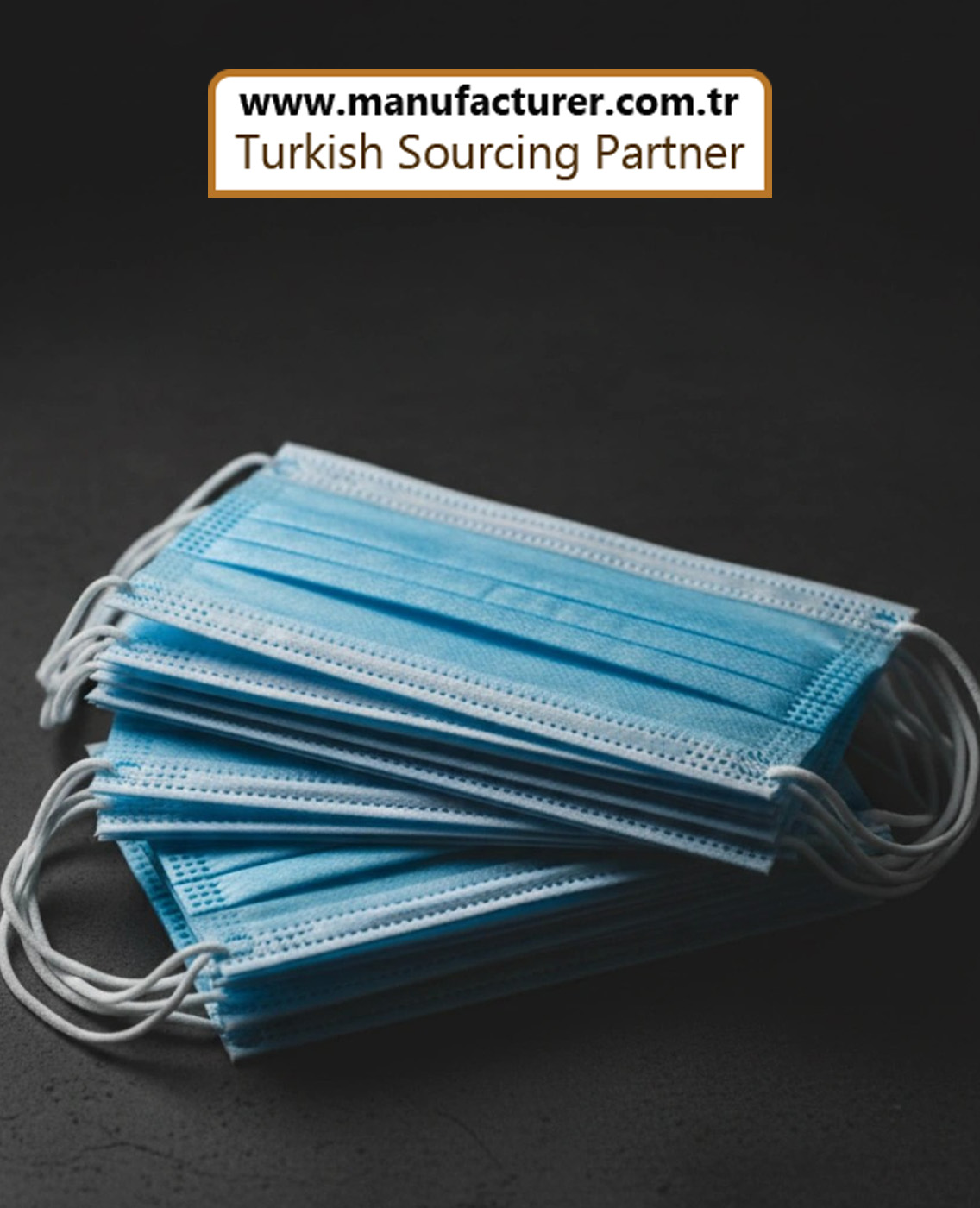
Disposable face mask is a single-use medical protective device designed to protect the face and respiratory tract. Disposable face mask creates an anatomical fit to facial contours through its multi-layered structure, elastic ear loops, and metal nose clip.
Disposable face mask functions as a biological barrier designed to reduce the transmission rate of aerosol particles. Disposable face masks manufactured in Turkey comply with ISO 13485 medical device standards, hold CE certification, and meet international filtration standards as professional-quality products.
Structural Components of Disposable Face Mask
Three-Layer (3-Ply) Structure
Outer Layer:
- Material: Spunbond nonwoven
- Function: Water-repellent protection
- Purpose: Creates barrier against external fluids
- Technical property: Hydrophobic polypropylene
Middle Layer (Filter Layer):
- Material: Meltblown polypropylene
- Function: Particle filtration
- Purpose: Electrostatic filtration capturing 0.3 micron particles
- Technical property: Electret technology application
- Filtration capacity: 95% to 99.97% (N95 standard)
Inner Layer:
- Material: Spunbond nonwoven
- Function: Comfort and moisture absorption
- Purpose: Minimizes skin irritation
- Technical property: Moisture-absorbent polypropylene
Disposable Face Mask Standards and Certifications
International Filtration Standards
ASTM F2100 Standard (USA):
- Level 1: Minimum protection (95% BFE – Bacterial Filtration Efficiency)
- Level 2: Moderate protection (98% BFE)
- Level 3: Maximum protection (99.97% BFE – N95 equivalent)
EN 14683 Standard (Europe):
- Type I: Minimum protection (95% BFE)
- Type II: Moderate protection (98% BFE)
- Type IIR: High protection (99.97% BFE) – Fluid-resistant
FFP Classification (Europe):
- FFP1: 80% filtration
- FFP2: 94% filtration (KN95 equivalent)
- FFP3: 99.97% filtration (N95 equivalent)
Turkey Standards:
- TS EN 14683: Classification of medical masks
- TS EN ISO 6529: Permeability testing of protective clothing
Technical Test Parameters
Bacterial Filtration Efficiency (BFE):
- Test organism: Staphylococcus aureus
- Aerosol particles: 0.3-10 micron
- Test pressure: 0.5 inches water column
Viral Filtration Efficiency (VFE):
- Test virus: Phi X 174 bacteriophage
- Aerosol particles: 0.1-5 micron
- Relevance: Coronavirus, influenza virus, etc.
Pressure Drop (Breathability):
- Measurement: Air flow resistance in Pascal
- Standard limit: < 75 Pa (for comfort)
- Clinical relevance: Breathing difficulty during extended use
Fluid Resistance (Splash Resistance):
- Test fluid: Synthetic blood (80 mmHg-120 mmHg pressure)
- Classification: Minimal, Low, Moderate, High
- Type IIR masks: High fluid resistance
Disposable Face Mask Manufacturers in Turkey
Turkish disposable face mask manufacturers possess the following technical capacities:
- ISO 13485:2016 – Medical device quality management system
- ISO 9001:2015 – General quality management system
- CE Declaration of Conformity – European market approval
- ASTM F2100 Level 3 compliance – N95 equivalent performance
- Automatic production lines – 100+ units per minute capacity
- Sterile manufacturing environment – ISO Class 7 clean room
Clinical Performance of Disposable Face Mask
Transmission Control Mechanism
Respiratory Droplet Prevention:
- Droplet size: 5-200 micron
- Transmission distance: 1-2 meters
- Disposable face mask effect: 95-99.97% reduction
Aerosol Prevention (N95 equivalent):
- Aerosol size: 0.1-5 micron
- Airborne duration: 2-3 hours
- N95 mask effect: 99.97% filtration
Contact Prevention:
- Reduction of direct contact risk
- Prevention of face and hand contact
- Lowered cross-contamination risk
Clinical Usage Duration
Standard Disposable Face Mask:
- Recommended usage time: 4-8 hours
- Moisture saturation limit: 80%
- Performance degradation: End of 8 hours
N95 Equivalent Mask:
- Recommended usage time: 8 hours
- Elastic durability: Extendable to 50% elasticity
- Reusability: Up to 5 times per CDC guidelines
Disposable Face Mask Selection Criteria: Clinical Perspective
Determining Appropriate Mask
Minimum Protection Requirements (Level 1/Type I):
- Patient examination (non-invasive)
- Hospital visits
- General cleaning procedures
Moderate Protection Requirements (Level 2/Type II):
- Clinical procedures
- Laboratory work
- Food processing
High Protection Requirements (Level 3/Type IIR, N95, FFP3):
- Surgical procedures
- Aerosol-generating procedures
- Infectious disease departments
- Intensive care units
Disposable Face Mask Filtration Mechanism
Electrostatic Filtration Theory
Negative electrical charge is created in the meltblown polypropylene fiber layer. Through this charge:
- Interception: Particles are captured on fiber surface from 1 micron distance
- Impaction: Fast-moving particles collide and stick to fiber
- Diffusion: Very small particles (<0.1 micron) are captured through diffusion
The combination of these mechanisms enables disposable face masks to achieve 99.97% filtration efficiency for 0.3 micron particles.
Disposable Face Mask Manufacturing Technology in Turkey
Production Process
- Nonwoven manufacturing: Thermalbond technology for outer and inner layers
- Meltblown filtration: Electret process application
- Lamination: Ultrasonic bonding of three layers
- Nose wire insertion: Plastic or metal wire
- Elastic ear loop: Polypropylene elastic fastening
- Quality control: Online and offline testing
- Packaging: Sterile packaging and sterilization
Sterilization Method
- Ethylene Oxide (EO): Standard method for medical masks
- Gamma Radiation: Alternative sterilization
- Autoclave: Heat-resistant mask application
Disposable Face Mask Performance Degradation
Contributing Factors
- Humidity: 2% performance decrease per 10% humidity increase
- Temperature: Oxidation rate doubles per 10°C increase
- Time: Electret activity decreases with storage duration
- Mechanical stress: Elastic stretching and release reduces performance
Shelf Life
- Standard storage: 3 years (room temperature, 50% humidity)
- Optimal storage: 5 years (15-25°C, 30-40% humidity)
Limitations of Disposable Face Mask
Technical Limitations
- Does not provide 100% protection: Contact transmission not prevented
- Ineffective if not properly fitted: Filtration failure if gaps exist
- Perspiration issues: Moisture accumulation reduces filtration
- Limited filtration lifespan: 4-8 hour usage limitation
User Error
- Improper fit: Mask not fitting face properly
- Reuse: Single-use masks not suitable for reuse
- Contamination: Virus particles on mask exterior
Conclusion: Clinical Role of Disposable Face Mask
Disposable face mask is a complex engineering product that becomes an effective protective tool through its multi-layered structure, electrostatic filtration principles, and standard compliance.
Disposable face masks manufactured in Turkey, as ISO 13485 and CE certified products, meet international quality standards and provide reliable protection in clinical environments.
Contact Us
For information about disposable face masks and other clinical protective products, including technical specifications, certifications, and bulk supply options, please contact us.